
People leave managers, not organizations. The Gallup Engagement Index confirms this year after year. Many organizations respond by establishing standards for effective leadership, yet those standards often fail to have the desired impact. A genuine participatory process produces more than a glossy brochure of leadership principles. It builds broad buy-in and accountability while generating valuable insights for reshaping HR's role.
In many organizations, employees experience both effective and ineffective leadership. Many managers operate under intense day-to-day pressure and focus primarily on subject-matter work. They make too little time for their leadership responsibilities and their employees' needs. Over time, dissatisfaction grows.
The City of Schaffhausen's administration faced a similar challenge. Its employee survey made the issue clear. Although the overall feedback was positive, employees criticized the existing leadership culture and leadership capabilities. HR was therefore asked to develop and establish a set of leadership principles.
A new Head of HR took over the project in January 2025, after it had been launched at the end of 2024. She quickly realized that the project would succeed only if HR acted, and was perceived, as a stronger partner to leaders and employees. In parallel, she launched an internal program to realign the HR function.
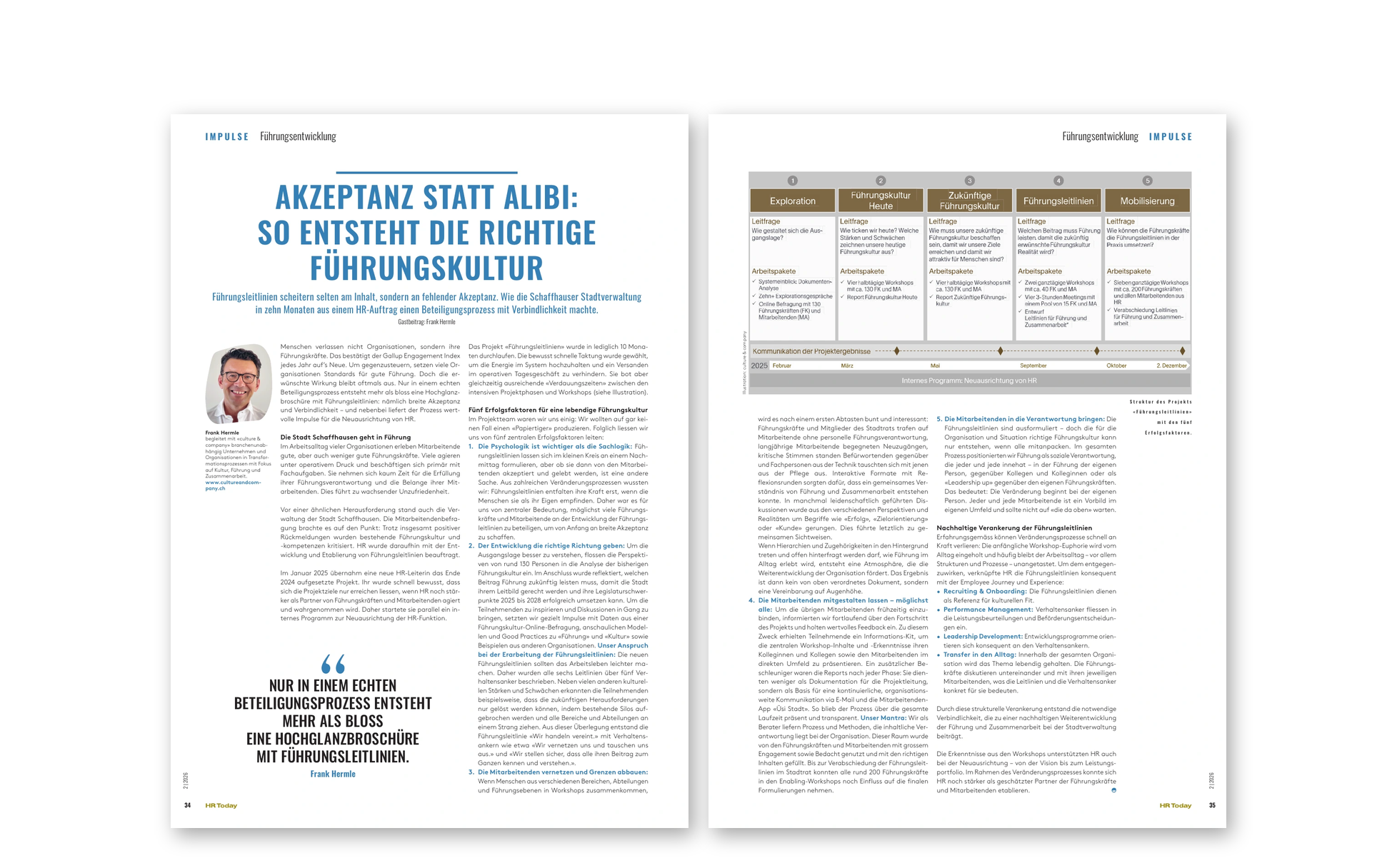
The Leadership Principles project was completed in just ten months. The deliberately brisk pace kept energy high and prevented the work from being swallowed by day-to-day business. At the same time, the schedule allowed participants enough time between the intensive project phases and workshops to absorb and process what they had learned.
The project team agreed from the outset that the principles had to change behavior, not merely look good on paper. Five success factors guided our work.
A small group can draft leadership principles in a single afternoon. Whether employees will accept and use them is another matter. Our experience with numerous change programs had taught us that leadership principles have impact only when people feel a sense of ownership. We therefore made it a priority to involve as many leaders and employees as possible in developing the principles, building broad buy-in from the outset.
To understand the starting point, we gathered input from around 130 people to assess the existing leadership culture. We then considered what leadership would need to contribute in the future for the city to live up to its mission and deliver on its 2025–2028 legislative priorities. We used results from an online leadership culture survey, practical models, examples of effective leadership and culture practices, and cases from other organizations to spark ideas and productive debate.
Our goal was simple: the new leadership principles should make work easier. We expressed each of the six principles through five behavioral anchors. Among other cultural strengths and weaknesses, participants recognized that the city's future challenges could be addressed only by breaking down existing silos and aligning departments around common goals. This insight led to the principle “We act as one,” supported by behavioral anchors such as “We build connections and share information” and “We make sure everyone knows and understands how their work contributes to the whole.”
When people from different functions, departments, and levels of leadership come together, the conversation becomes more varied and productive once the initial hesitation subsides. Leaders and City Council members met with employees who had no people-management responsibilities. Long-tenured employees met recent hires, skeptics engaged with supporters, and technical professionals exchanged perspectives with colleagues in nursing care. Interactive formats and reflection rounds helped the group develop a shared understanding of leadership and collaboration. At times, discussions became passionate as participants worked through different interpretations of terms such as “success,” “goal orientation,” and “customer.” Ultimately, they reached common ground.
When hierarchies and organizational boundaries recede and people can openly question how leadership is experienced day to day, the organization can learn and improve. The result is not a document imposed from above, but a shared commitment developed on equal footing.
To involve the rest of the workforce early, we provided regular updates on the project's progress and invited valuable feedback. Participants received an information kit so they could share the main workshop content and findings with colleagues and the people they worked with most closely. Reports issued after each phase created additional momentum. They served less as documentation for the project team and more as the basis for ongoing, organization-wide communication by email and through the “Üsi Stadt” employee app. This kept the process visible and transparent throughout the project.
Our mantra was clear: as consultants, we provide the process and methods; the organization owns the content. Leaders and employees engaged thoughtfully and used the opportunity to define the content themselves. Until the City Council formally approved the leadership principles, all roughly 200 leaders could still shape the final wording through the enablement workshops.
The leadership principles had been drafted, but the right leadership culture for the organization could emerge only if everyone participated. Throughout the process, we positioned leadership as a social responsibility shared by everyone: in managing themselves, in how they work with colleagues, and in leading up with their own managers. The message was straightforward. Change starts with the individual. Every employee sets an example in their own sphere of influence and should not wait for “those at the top.”
Change programs can quickly lose momentum. The initial enthusiasm generated in workshops gives way to daily pressures, while day-to-day work, especially structures and processes, often remains unchanged. To prevent that, HR embedded the leadership principles throughout the employee journey and experience.
Recruiting and onboarding: The leadership principles serve as a reference point for cultural fit.
Performance management: The behavioral anchors are incorporated into performance reviews and promotion decisions.
Leadership development: Development programs are consistently aligned with the behavioral anchors.
Application in daily work: The organization keeps the topic active. Leaders discuss with one another and with their teams what the principles and behavioral anchors mean in practice.
By embedding the principles in these systems, the city created the accountability needed to sustain improvements in leadership and collaboration across the municipal administration.
The workshop findings also supported HR's own realignment, from its vision to its service portfolio. Through this change process, HR further strengthened its position as a valued partner to leaders and employees.


